
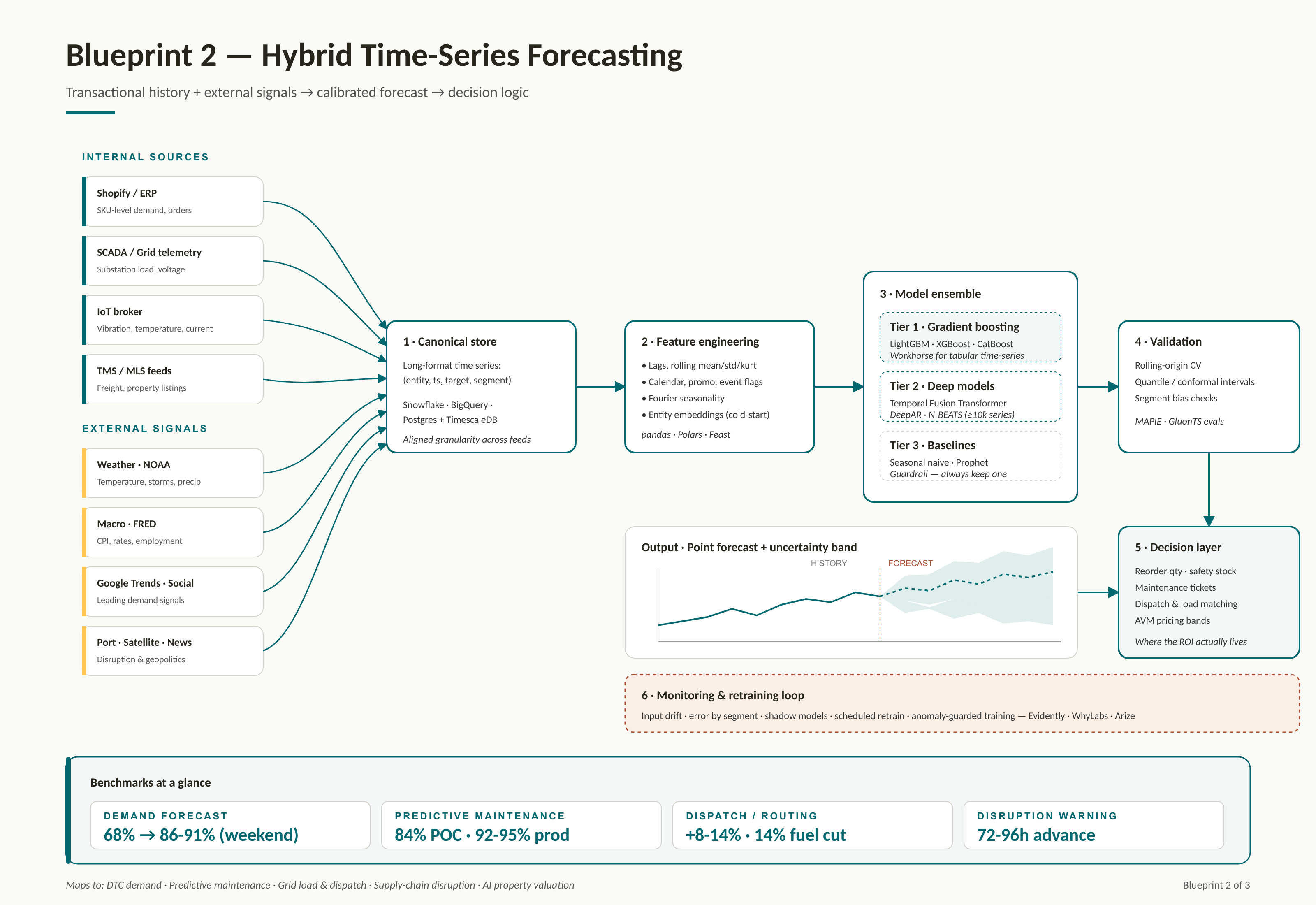
Blueprint - Hybrid Time-Series Forecasting with External Signals

|
One-line summary A gradient-boosted or deep-learning forecaster that fuses transactional history with exogenous signals (weather, social, macro, telemetry), retrains on a rolling window, and returns a point forecast plus a calibrated uncertainty band that downstream decision logic can act on. |
Reference architecture
|
Hybrid Time-Series Forecasting with External Signals |
|
1. Canonical time-series store One long-format table: (entity_id, timestamp, target, segment). Sources: Shopify / ERP for retail, SCADA for grid, IoT broker for sensors, TMS for logistics, MLS + assessor feeds for property. |
|
▼ |
|
2. External signal ingestion Scheduled jobs pull weather (NOAA / OpenWeather), Google Trends, social sentiment, macro (FRED), port congestion, satellite imagery, news disruption feeds. Aligned to the base series granularity. |
|
▼ |
|
3. Feature engineering Rolling statistics (mean, std, kurtosis), lag features, calendar features, promotion and event flags, Fourier seasonality terms, entity embeddings for new-item cold start. |
|
▼ |
|
4. Model ensemble Tier 1 - gradient boosting (LightGBM / XGBoost) as the workhorse. Tier 2 - deep model (TFT, DeepAR) for long-horizon, multi-series. Tier 3 - simple baselines (seasonal naive, Prophet) as a guardrail. |
|
▼ |
|
5. Validation and calibration Rolling-origin cross-validation, held-out seasons, quantile regression or conformal prediction for calibrated intervals, bias checks by segment. |
|
▼ |
|
6. Decision layer Forecast + uncertainty feed directly into decisions: reorder quantities, maintenance tickets, dispatch tweaks, load matching, property pricing. This is where the ROI actually lives. |
|
▼ |
|
7. Monitoring and retraining Drift monitoring on both inputs (covariate drift) and outputs (error by segment); automated retraining trigger; shadow models run in parallel before promotion. |
Technology behind
|
Layer |
Recommended technology |
Notes |
|
Data warehouse |
Snowflake, BigQuery, Databricks, or Postgres + TimescaleDB |
Pick one and keep time-series in long format. |
|
Orchestration |
Airflow, Dagster, or Prefect |
Same DAG runs ingest + feature build + train + score. |
|
Feature engineering |
pandas + Polars; feature store (Feast) once you have > 1 team |
Reuse features between batch training and online scoring. |
|
Core model |
LightGBM (tabular baseline), XGBoost, CatBoost |
Still wins most tabular time-series benchmarks. |
|
Deep model (optional) |
Temporal Fusion Transformer, DeepAR (GluonTS), N-BEATS |
Worth it above ~10k series with rich covariates. |
|
Baselines |
Prophet, seasonal naive, ARIMA |
Keep at least one simple baseline in production. |
|
Uncertainty |
Quantile regression or conformal prediction (MAPIE) |
Point forecasts alone do not drive good decisions. |
|
Serving |
Batch scoring via warehouse + Airflow; real-time via FastAPI + ONNX |
Most forecasting use cases are batch, not real-time. |
|
Monitoring |
Evidently, WhyLabs, Arize, or custom dashboards on forecast error |
Track error by segment, not just global. |
|
Compute |
Google Colab / single GPU for POC, Ray or Spark for production |
Weekend POC on $47 of cloud compute is realistic (retail article). |
Architectural pros and cons
|
Architectural Pros |
Architectural Cons |
|
• Gradient boosting is cheap, fast to iterate, and strong on mixed tabular + time features. • External-signal fusion turns flat series (retail SKU, substation load, sensor channel) into rich feature sets. • Calibrated uncertainty bands unlock proper decision logic: safety stock, maintenance thresholds, dispatch guardrails. • Weekend POC is genuinely achievable - a single engineer with Python and Colab can hit 85-90% of enterprise accuracy (retail article). • The same blueprint generalizes across retail, maintenance, grid, logistics and real estate with only feature changes. |
• Cold start remains hard - new SKUs, new sensors, new properties have no history. Needs embedding or hierarchical priors. • One-time shocks (viral moments, pandemics, geopolitical events) wreck models trained on stable regimes. • Drift is inevitable - a model trained on 2023 data will degrade by late 2025 without retraining (retail article). • Signal acquisition has real operational cost (weather APIs, social sentiment, port data, satellite imagery). • In regulated contexts (AVMs for lending, grid dispatch) model confidence bounds need formal validation, not just holdouts. |
Use cases
• DTC demand forecasting: SKU-level daily forecasts combining Shopify history, promotions, Google Trends, weather and social sentiment. Prevent stockouts on high-margin items, avoid seasonal overstock.
• Predictive maintenance: Classify or predict remaining useful life from vibration, temperature, current draw; rolling statistics (especially kurtosis) over 5 / 30-minute windows; 4-6 hour advance warning of bearing failures.
• Grid load and dispatch copilot: 5-minute interval load forecasts for a substation; recommendation engine suggests dispatch tweaks based on forecast uncertainty; human approves with a single click.
• Supply-chain disruption prediction: Weather + port congestion + carrier capacity + geopolitical risk feeds produce 72-96 hour advance disruption alerts; pre-clear containers via alternate ports.
• AI property valuation and pricing: Assessor records, permit histories, satellite / street imagery, walkability, school trajectories feed a valuation model that produces a point estimate plus a risk-flagged confidence interval.
• Empty-mile reduction for freight: Aggregate shipper demand, predict corridor demand from leading indicators, pre-position capacity before loads are formally tendered.
Benchmarks
|
Use case |
Baseline |
This blueprint |
Source |
|
DTC demand forecast accuracy |
68-75% (spreadsheet) |
86-91% (weekend build) |
Retail article |
|
Enterprise demand forecast accuracy |
n/a |
92-95% |
Retail article |
|
Predictive maintenance precision |
Reactive only |
84% POC / 92-95% production |
Manufacturing article |
|
Unplanned downtime reduction |
0% |
20-40% |
Siemens / Bosch / Deloitte |
|
Battery dispatch arbitrage uplift |
Rule-based |
+8-14% |
Energy article |
|
Route optimization fuel savings |
Legacy routing |
14% (expected 5-7%) |
Logistics article |
|
Empty-mile reduction |
15-25% empty |
-25 to -35% |
Logistics article |
|
Supply-chain disruption warning |
Reactive |
72-96 hours ahead |
Logistics article |
|
AVM pricing accuracy in dense markets |
+/- 5-8% (appraiser) |
Tighter in well-covered markets, wider elsewhere |
Real-estate article |
Failure modes to plan for
• New-product launches: no history to anchor on - use hierarchical models and similar-item embeddings.
• Viral shocks: one-time demand spikes destabilize models; anomaly-detect and cap training influence.
• Thin-data markets: confidence intervals widen dramatically in rural or specialty segments; surface this uncertainty, do not hide it.
• Garbage telemetry: shift-change spikes, logger gaps, vendor-compressed signals are real; clean before modelling.
• Drift: treat the model as a living system, not a one-time project; monitor error by segment and retrain on schedule.
Comments (0)
Join the conversation!