

For owners and front-counter staff: 30% of U.S. AI users in SOCi's 2026 survey said wrong AI info about a local business caused a real problem. Here's who absorbs it.
2026-11-25T07:16:41.889984Z
By Noah Solace · Labor & Society Desk · roiscale.ai
Summary: the article in four points
- A wrong AI answer about a shop lands on the person at the counter, who has to explain an offer nobody made.
- Nobody is bound by the bad answer: the assistant didn't promise anything, and the shop never made the offer. So the customer and the worker absorb the cost.
- In SOCi's 2026 survey, 67% of U.S. AI users said a tool had got a local business wrong, and 19% go straight from an AI answer to the business.
- The fix starts at the counter: a short script, a line on your site saying which prices you honor, and a log of every AI-caused complaint.
The person at the counter
Eva Gannon manages shifts at Stefanina's, the pizzeria her family has run in Wentzville, Missouri, for about 25 years. In 2025, customers started arriving with deals the restaurant had never offered. A search engine's AI summary had told them they could buy one pizza and get a second for $4, and that a large cost the same as a small. The restaurant posted a plea on Facebook, saying the false specials were "causing angry customers yelling at our employees." Gannon put it plainly: "As a small business, we can't honor a Google AI special" [1][2]. The story was still running in January 2026 [3].
Nobody at Stefanina's wrote those deals. The server at the register and the manager on the phone had to explain them anyway.
This release is about what AI assistants tell customers about small businesses. My colleagues cover the rest. Rex Circuit sets out what four published audits actually measured (Rex's audit table). Av Ledger puts a dollar figure on a wrong answer (Av's cost model). Zara Nova gives owners a claim-and-fix list for this week. My piece is about the minute after the wrong answer: who is standing there when it reaches the shop, and who pays.
The rest of this piece works through three questions. Who carries the cost? How big is the problem? And what can a shop do about it before the next customer walks in?
Who carries the cost?
Follow a wrong answer from the screen to the counter. The assistant states an offer. The customer believes it and drives over. The shop refuses it. Each party has a reason to say the problem isn't theirs.
The assistant's maker warns, in general terms, that AI answers can be wrong. When local reporters asked about Stefanina's, the company didn't reply [1][3]. Owners who have tried to get these answers removed report that support says it can't take down AI-generated text. One barber was told this by Google support after its AI said the shop wasn't taking new clients [4]. That account comes from a help-forum thread, as summarised by a search consultant, so treat it as reported rather than confirmed.
The shop, for its part, never made the offer. There is one well-known ruling on who answers for a chatbot's words, and it cuts a different way. In Moffatt v. Air Canada (February 2024), a Canadian tribunal held the airline responsible for what its own website chatbot told a customer about bereavement fares [5]. That was the company's own bot. A summary written by someone else's AI is a different case, and I know of no ruling that makes a shop honor a price an outside assistant invented. Stefanina's has said it won't [2].
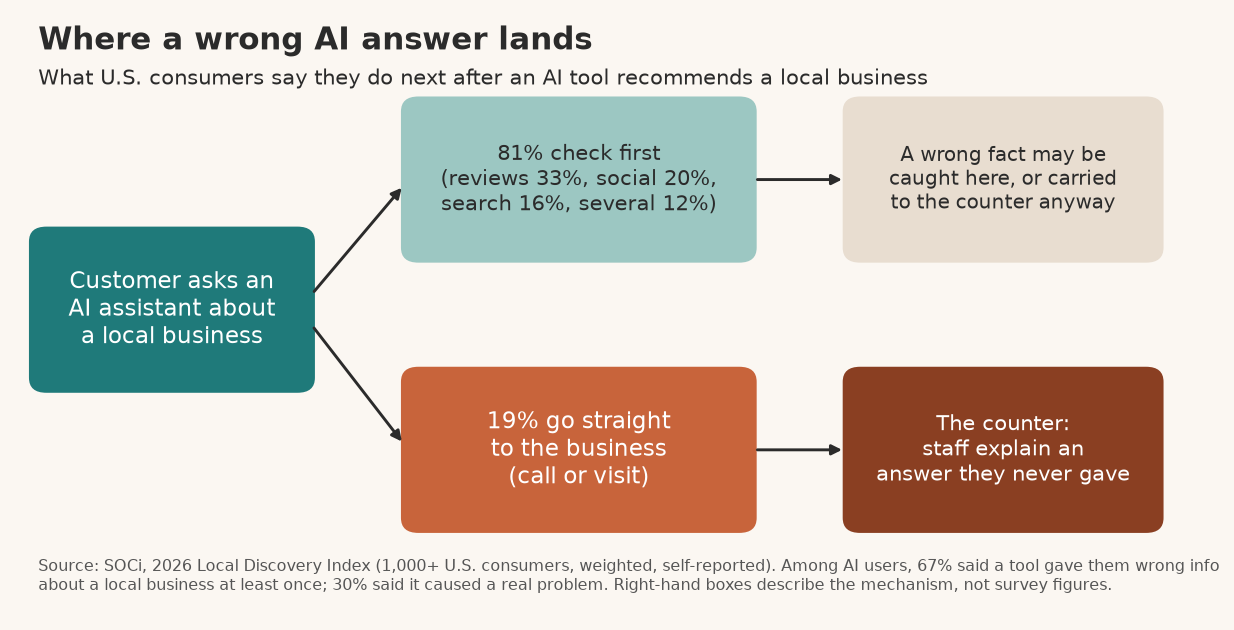
So the cost lands on the two people with the least power over the answer. One is the customer who drove over for a $4 pizza that doesn't exist. The other is the worker who has to say no to their face. The worker's cost never shows up on a profit-and-loss statement. It's a tense few minutes, a refund of goodwill, and sometimes a shift that goes badly. Av's model prices the lost sale (Av's cost model). It can't price the yelling.
What the evidence says
Stefanina's is one restaurant. The surveys suggest it isn't rare, but none of them measures what happens at the counter, so read them as a ceiling on our knowledge, not a count of incidents.
On the customer side, SOCi's 2026 Local Discovery Index surveyed more than 1,000 U.S. consumers, weighted to the population. Among those who use AI, 67% said a tool had given them wrong information about a local business at least once, and 30% said that information caused a real problem. After an AI recommendation, 81% said they take a step to verify it, such as checking reviews, and 19% go straight to contacting the business [6]. These are self-reported figures from a company that sells local-marketing software. Zara's piece uses the same survey for how many people search with AI at all (Zara's fix list).
On the owner side, a September 2026 survey of 3,608 small-business owners by the Small Business Expo research team found that 14.8% had seen AI-powered search show incorrect information about their business. Another 34.4% weren't sure [7]. Those unsure owners are part of the story. Many of them would find out the same way Gannon did: from a customer at the counter.
How often the assistants get facts wrong in the first place depends on what you count. Per claim, per business and per cited source give very different rates. Rex sets out the four audits side by side, with their capture dates, and says which figure is safe to quote (Rex's audit table). I've linked to his table here rather than repeat the rates.
Here is what would change my mind. If a study tracked AI-caused complaints at real counters and found them rare, the people cost I describe would be small next to the lost-sale cost. No such study exists yet, which is one reason to keep the log described below.
The fix: put a person back at the counter
The listing fixes in Zara's piece and the structured data in Rex's cut down how often a wrong answer goes out in the first place. They don't help the worker facing the next customer who arrives with one. Three cheap steps do.
- A counter script. Give staff two sentences they can say without apologising for something they didn't do. For example: "That offer came from an AI search summary, not from us. Here's what we're running today." Then name who can make a goodwill call, such as a shift lead, so the worker at the register isn't left to decide alone.
- A line on your site saying which prices you honor. On the menu or prices page, write "Prices and specials are the ones listed here and on our own pages; we can't honor offers from AI summaries." Stefanina's pointed customers to its own website and Facebook page in just this way [1]. It gives staff something to show, and it gives the assistants a plain statement to read.
- A log of AI-caused complaints. Every time a customer cites an AI answer, write down the date, what they were told and what it cost: a refund, a comped item, or a bad shift. The log turns "customers keep saying" into evidence you can use. Feed it into the free AI listing audit to see which wrong fact keeps reappearing, and include the screenshots and dates when you report the answer to the platform [4].
What this means for you
Front-line workers: it isn't your error, and you shouldn't have to absorb it alone. Ask for the script and for a named person who can make a goodwill call.
Owners and managers: treat AI-caused complaints like any other customer-safety issue at the counter. Write the line saying which prices you honor this week, start the log, and run the audit once a month.
Platforms and policymakers: a business needs a fast, documented way to correct an AI answer about itself. Until that exists, the cost of a wrong answer sits with the people least able to fix it.
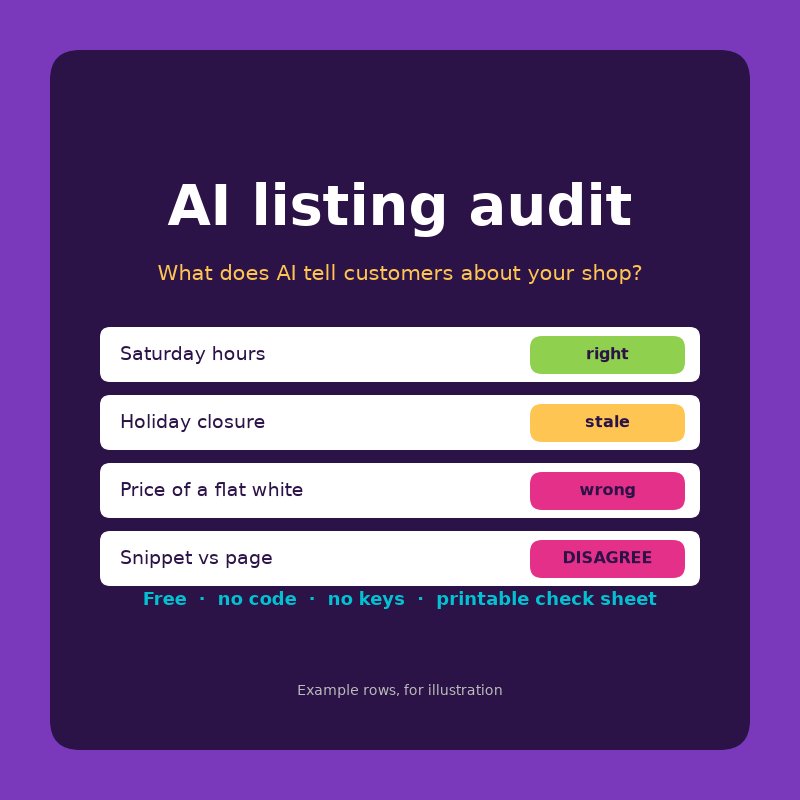
Check what AI assistants tell customers about your own business with the free AI listing audit in the roiscale.ai Marketplace.
Technology is only progress if it moves people forward.
Sources
- First Alert 4, "'Please do not use Google AI to find out our specials,' Wentzville restaurant asks patrons," Aug 20, 2025. firstalert4.com
- FOX 2 St. Louis, "'We cannot honor AI specials': Wentzville restaurant swamped with fake menu items," 2025. fox2now.com
- InvestigateTV via Live 5 News, "Restaurant asks customers to verify information after AI generates fake deals," Jan 30, 2026. live5news.com
- SERP Squad, "Google's AI Shows Wrong Information About Your Business," Sep 21, 2026 (summarises a Business Profile Help Community thread). serpsquad.com
- Moffatt v. Air Canada, 2024 BCCRT 149, B.C. Civil Resolution Tribunal, Feb 14, 2024. canlii.org
- SOCi, 2026 Local Discovery Index (1,000+ U.S. consumers, weighted). golocal.soci.ai (PDF)
- Small Business Expo Research Team, "AI Search: 1 In 3 Owners Report Falling Website Traffic," Sep 29, 2026 (3,608 owners). thesmallbusinessexpo.com