


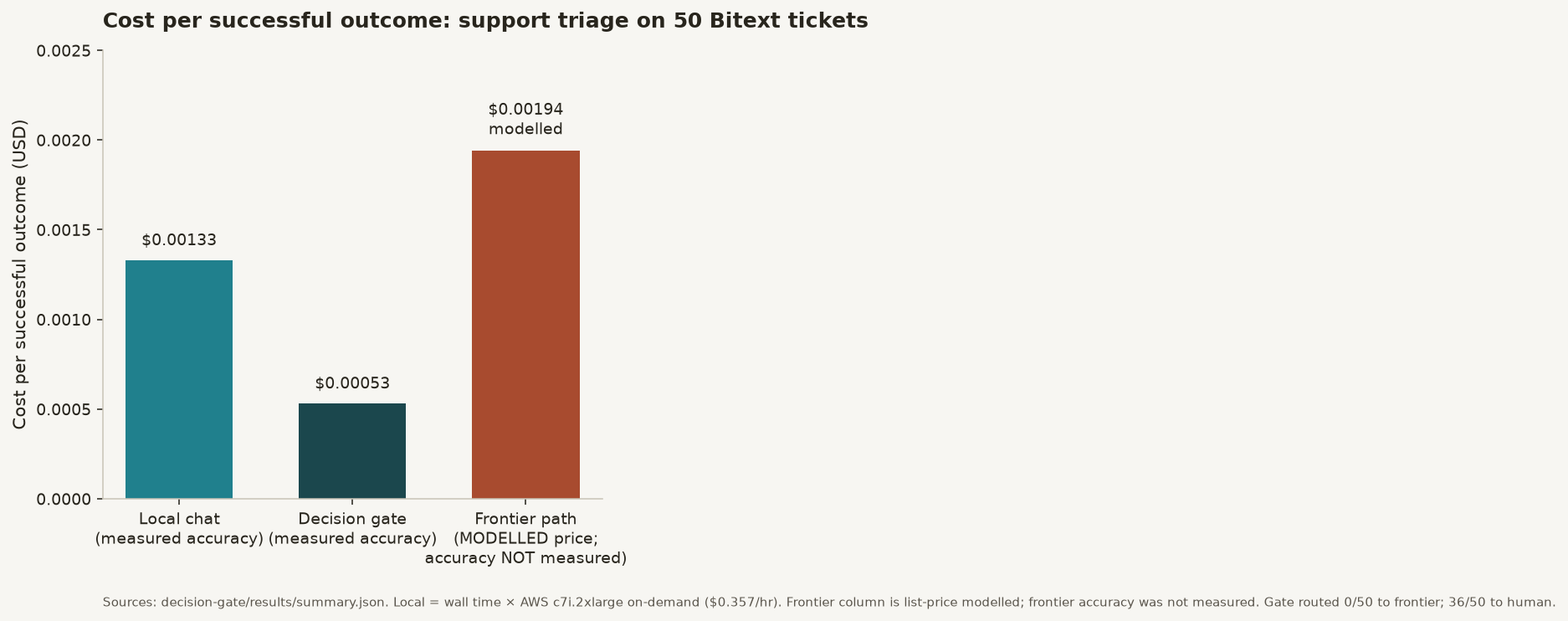
Token spend in most support organizations has no owner and no P&L line, so no one can say what a resolved ticket costs. The fix is a workflow map: owner, line, and cost per successful outcome. On 50 measured tickets, a decision gate cut modelled local inference cost per correct outcome 60%. The bill moves; much of it moves to human review.
| COST PER SUCCESSFUL OUTCOME (MODELLED) | OUTPUT TOKENS (MEASURED) | WALL TIME (MEASURED) | HUMAN ROUTES (MEASURED) |
|---|---|---|---|
| $0.00133 → $0.00053 (↓60%) | 5,483 → 192 (↓96.5%) | 671.5 s → 257.9 s (↓62%) | 36 of 50; 29 low-confidence (↑ labor) |
Chat model qwen3.5:4b vs decision gate tev1:4b, threshold 0.8, 50 public Bitext tickets, one shared CPU box. Cost figures modelled.
Price the Outcome, Not the Token
A CFO cannot approve, cut or defend a line measured in tokens. The right unit is cost per successful outcome: total workflow cost divided by cases resolved correctly. Stop any workflow that cannot show that ratio. Route every workflow that passes to the cheapest model that holds accuracy, which in our test was not the frontier model.
Why the Bill Has No Owner
BCG stated the structural problem on 1 July 2026: tokens land in capex, opex or COGS depending on use, and a frontier model costs roughly 5 to 25 times more per token than a simple one. Context is rebilled on every agent loop, so a session that feels twice as long can cost four times as much. Forecasts miss accordingly: IDC, reported by CIO.com on 19 December 2025, expects Global 1,000 companies to underestimate AI infrastructure costs by about 30% through 2027.
Before and After: Measured Unit Economics
We ran 50 public Bitext support tickets through two local setups on one CPU box: a chat model and a decision gate that acts only at 0.8 confidence.
| Metric (n=50) | Chat model | Decision gate |
|---|---|---|
| Input tokens | 21,125 | 50,645 (↑140%) |
| Output tokens | 5,483 | 192 (↓96.5%) |
| Wall time | 671.5 s | 257.9 s (↓62%) |
| Category accuracy | 100% | 96% |
| Intent accuracy | 94% | 90% |
| Cost per successful outcome (MODELLED) | $0.00133 | $0.00053 |
Input tokens rose because the gate reads more context per decision; that cost belongs on the map. The gate is cheaper and slightly less accurate. Cost is priced at the AWS c7i.2xlarge on-demand rate of $0.357 per hour. The box was shared, so wall time is noisy; token counts are not. For reference, sending all 50 tickets to a frontier model at public list prices is a MODELLED $0.097 to $0.194. No ticket was sent there, and frontier accuracy was not measured.
Where the Saving Goes: Human Review
The router sent 0 tickets to the frontier, 14 to the small model and 36 to a human. Of those 36, 29 were low-confidence fallbacks: no option reached 0.8, so the gate deferred. Each human route books to support labor, not inference, and costs far more than a fraction of a cent. We count it as cost, not saving. The inference saving is real but small per ticket; review load decides the economics.
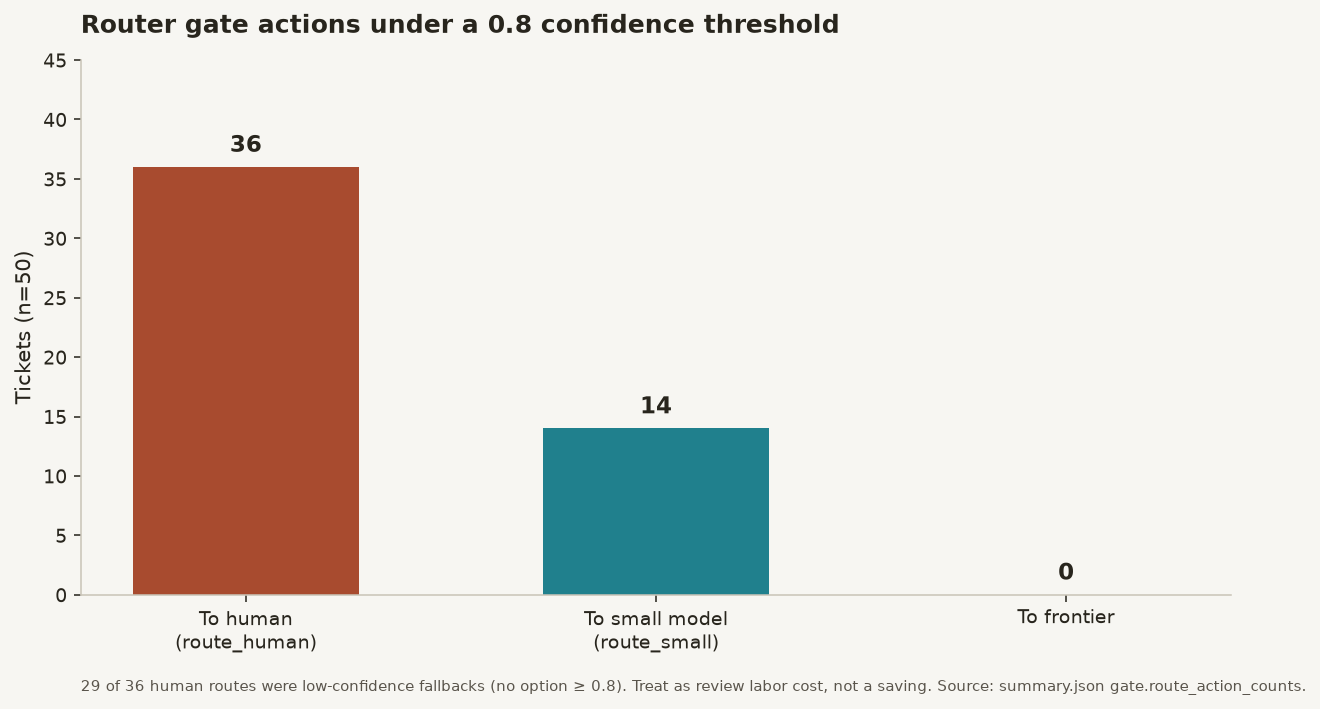
The threshold is the CFO's lever. Recomputed from the same run's scores with no new model calls:
| Threshold | To human | Of which low-confidence | To small model | To frontier |
|---|---|---|---|---|
| 0.5 | 19 | 2 | 30 | 1 |
| 0.6 | 26 | 13 | 23 | 1 |
| 0.7 | 30 | 20 | 19 | 1 |
| 0.8 (tested) | 36 | 29 | 14 | 0 |
| 0.9 | 41 | 39 | 9 | 0 |
Accuracy was measured only at 0.8. A lower threshold cuts review labor and admits more machine decisions; price both before moving it.
Payback: A 24-Month Envelope
Deloitte's survey of 1,854 executives, published 22 October 2025, found the typical AI use case reaches satisfactory ROI in two to four years; only 6% see payback inside one year. We set 24 months as the envelope. The arithmetic needs client data: monthly volume times the change in cost per successful outcome, minus added review cost, against the cost of implementation. We hold no honest peer-quartile data for this workflow, so we quote none. A workflow that cannot clear 24 months on its own volume should be stopped, not scaled.
What We Sell
The stop gate and router come from Rex Circuit's Decision Gate toolkit, free on registration; make sweep rebuilds the threshold table above. roiscale.ai sells the P&L map: a workflow map and readout for one support workflow, naming the owner, the line and the cost per successful outcome, with stop and route decisions attached.
The Takeaway
- The number: modelled local inference cost per successful outcome fell 60%, from $0.00133 to $0.00053, on 50 measured tickets.
- The mechanism: give each workflow an owner, a P&L line and a cost-per-outcome ratio; stop what fails it and route the rest off the frontier model.
- The risk: 29 of 36 human routes were low-confidence fallbacks and category accuracy fell 4 points; untuned, the gate shifts cost from inference to labor.
Read with: Rex Circuit on the gate itself; Zara Nova on the stop gate; Dr. Orion Kade on errors that pass; Noah Solace on the person rejected.
Sources
- BCG, 1 July 2026: How CEOs can optimize AI token costs
- IDC via CIO.com, 19 December 2025: CIOs will underestimate AI infrastructure costs by 30%
- Deloitte, 22 October 2025: AI ROI: the paradox of rising investment and elusive returns
- Decision-gate run data and code: mskrado/poc, decision-gate
- Bitext: customer support LLM chatbot training dataset